You can freeze some cake batters, but freezing is not equally successful for every cake. A sturdy batter made for that method is a better candidate than a delicate egg-foam batter. For most home bakers planning ahead, baking the cake layers first and freezing them is the more predictable option.
The question has two parts: will the batter bake into the texture you want, and can you handle it safely? Freezing may pause storage, but it does not undo gas already lost, repair a broken emulsion or make raw flour and eggs safe to eat.
Choose your make-ahead plan before mixing
Compare three make-ahead plans before mixing
The first plan is to measure dry ingredients and prepare equipment ahead, then mix fresh batter when you are ready to bake. Keep ingredients protected and labeled, and store any perishable items appropriately. This reduces final-day work without asking mixed batter to survive freezing.
The second plan is to bake suitable plain layers ahead and freeze them using the recipe's directions. The structure is already set, and decorating can happen later. This is often the most practical option when reliability matters more than having the batter itself ready.
The third plan is to freeze batter under a method developed for that purpose. It can fit some routines, but it requires attention to formulation, portioning, thawing and baking. Choose it because the recipe supports it, not simply because a container is available.
Why a commercial frozen batter is not a home precedent
A commercial product can use ingredients, leavening systems and process controls chosen specifically for storage. Its instructions belong to that product. A homemade bowl using different flour, fats and mixing equipment is not an equivalent system.
Do not infer that a successful supermarket muffin proves every foam cake will freeze well as raw batter. Product category names are broad. The relevant information is the actual formula and intended method.
Identify the cake before choosing a method
| Batter type | Why freezing needs caution | More predictable plan |
|---|---|---|
| Ordinary butter or oil cake | Leavening and mixture stability can change | Use recipe-specific instructions or freeze baked layers |
| Egg-foam sponge or angel food | Air structure is delicate | Mix and bake promptly as directed |
| Batter explicitly formulated for freezing | Method is part of the recipe | Follow its packaging, thawing and baking instructions |
| Unfamiliar commercial-style formula | May depend on special ingredients and process controls | Do not assume home substitutions behave the same |
“Cake batter” is not one standardized product. A batter lifted by whipped eggs and one lifted by chemical leavening have different vulnerabilities. A method that works for one recipe cannot automatically be transferred to another.
A realistic event-preparation decision
If you have an important celebration in several days, do not make an untested frozen-batter method the only route to dessert. Bake an appropriate layer cake ahead, or mix fresh batter close to baking. Keep the process familiar where reliability matters.
If your goal is occasional small cupcakes, look for a recipe specifically offering batter freezing or a smaller-batch formula. A measured, repeatable method serves that goal better than keeping a random bowl of leftovers.
Use the pan-size guide when dividing a batch. Smaller portions can change depth and baking time, so container volume alone does not tell you which pan to use.
Why some batters are better candidates than others
What happens to leavening during a wait
Once dry and wet ingredients meet, some leavening reactions begin. Bubbles that form and escape before baking do not return simply because you freeze the mixture. The speed and extent depend on the formula and its conditions.
Double-acting baking powder includes a heat-related stage, which can make it more suitable than a solely early-reacting system in some make-ahead formulas. That is not a guarantee of identical volume after freezing. The batter's ability to hold air and gas still matters.
The American Society of Baking's discussion of frozen chemically leavened goods describes formulation and process considerations. Commercial frozen batter is designed for that use; its existence does not prove every homemade cake batter will behave the same way.
Do not add extra powder as insurance
Extra leavener can create an unpleasant flavor or excessive expansion that the batter cannot support. If a freezing method requires a different formula, use that formula rather than sprinkling additional powder into a recipe that was not designed for it.
For the underlying chemistry, read baking soda versus baking powder. Understanding reaction timing is useful; improvising a universal correction is not.
Air and emulsions can change too
A cake's rise may include air incorporated during creaming or whipping. A delicate foam can lose volume during storage and thawing. Vigorous remixing does not necessarily restore its original structure and can further alter the batter.
Mixtures of fat and water can also change as ingredients freeze and thaw. Some batters remain workable, while others separate or become uneven. The presence of eggs, dairy, sugar and stabilizing ingredients affects the result.
That is why a small quality trial is sensible when a reliable source permits freezing but your exact recipe has not been tested by you. Make one small portion, label the change and compare it with the freshly baked version. Do not describe an illustrative photograph as proof of a successful trial.
If you freeze batter: build a safe, usable portion
Handle batter as raw food
Raw flour can carry harmful bacteria, and raw eggs can present risks too. The FDA advises against eating raw flour, dough and batter. Freezing is not a substitute for the appropriate baking step.
Use clean utensils and containers. Avoid moving back and forth between raw batter and finished food without cleaning. Do not let children use raw batter as a play material or taste it while waiting for a container.
Keep preparation efficient and follow safe time-temperature guidance for perishable ingredients. Do not leave mixed batter on the counter for an open-ended period before freezing. A batch with uncertain handling history is not a good candidate for saving.
Plan the thaw before you freeze
Refrigerated thawing is a sensible default for a perishable batter when the recipe calls for thawing. Use a leakproof container and protect other food. Do not put the batter on the counter overnight to hurry it along.
Do not assume it is safe to bake directly from frozen in any pan. Some formulas provide that method, but an unplanned frozen block can heat unevenly and require a different schedule. Glass bakeware also has manufacturer-specific temperature-change limits.
Design the portion around the future bake
If you want a few cupcakes at a time, a container holding the full batch creates an inconvenient thawing problem. Use a method that permits measured smaller portions, label the amount, and know which pan and liner setup will receive it later.
Do not assume a frozen portion can be moved into any cup or pan with no adjustment. Batter depth and starting temperature change how heat reaches the middle. Use the recipe's directions for the portion size or choose a fresh small-batch recipe instead.
Record enough to avoid guessing later
Label the recipe name, portion weight, preparation and freezing dates, and where the thawing instructions are stored. A freezer bag marked only “cake” does not tell you whether it contains baked crumbs, butter-cake batter or a mixture with a different handling need.
Keep a copy of any changed method. If you performed a small quality trial, write down the result and the exact process. Without that record, a second attempt can unknowingly use a larger portion, longer warm interval or different pan.
Use an important event as a reason to simplify
When guests are depending on the result, use the method you have reason to trust. An unfamiliar frozen-batter technique adds uncertainty at the same time that you have less opportunity to repeat the bake. Baking suitable layers early can remove that pressure.
If you enjoy experimenting, do it with a small, safely handled batch on an ordinary day. The experiment should answer a question about your recipe's quality, not create a new food-safety rule. Keep raw-food handling guidance unchanged even if the cake looks successful.
A make-ahead method is useful when it makes the whole sequence easier. If freezing introduces unclear thawing and timing decisions, the apparently convenient shortcut may be less practical than fresh mixing with premeasured ingredients.
If the recipe supports freezing, package carefully
- Read the recipe's freezing and thawing directions before mixing.
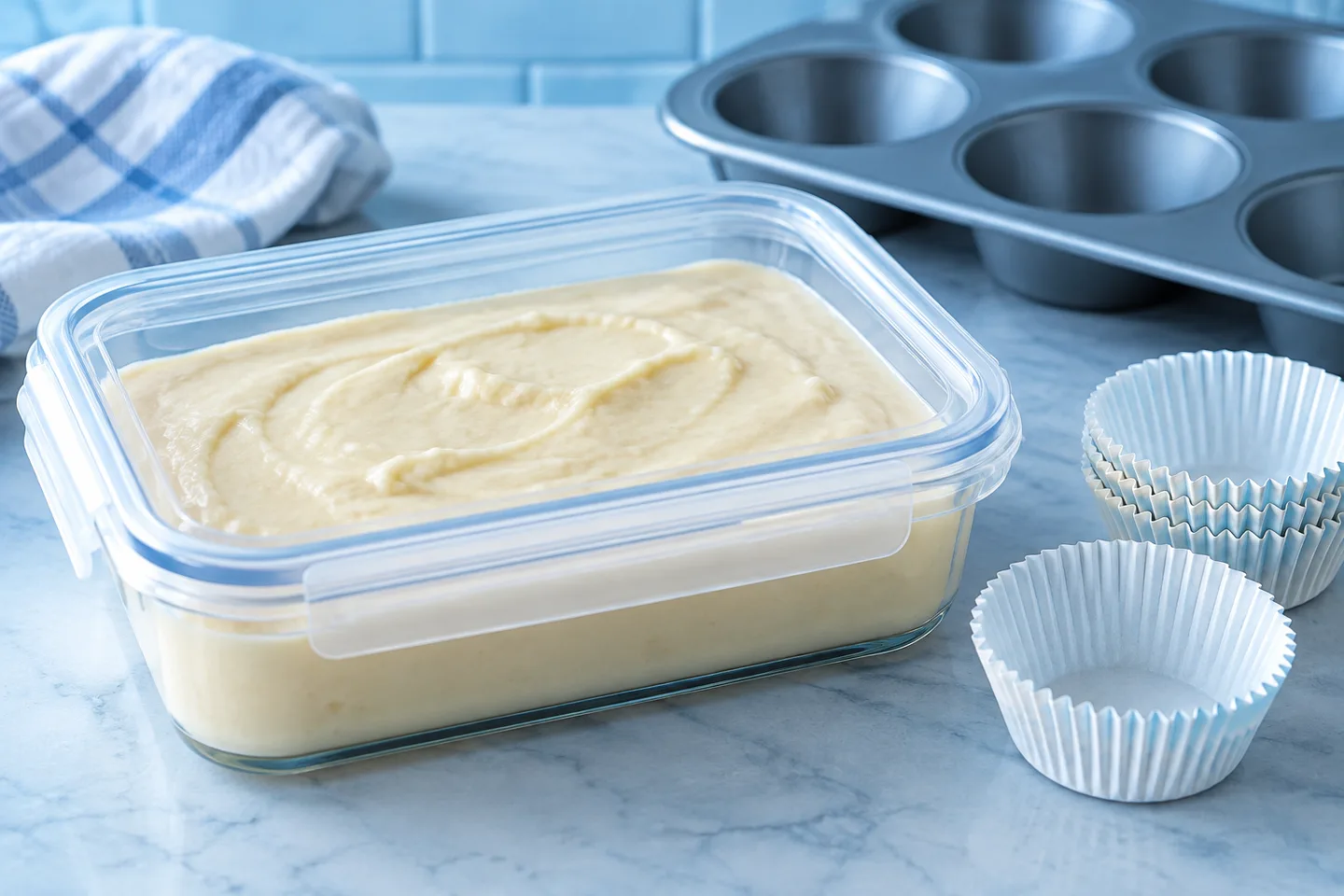
- Prepare a clean, freezer-safe container of an appropriate size.
- Portion the batter so you can use one batch without repeatedly thawing the rest.
- Leave any expansion space the container instructions require and close it securely.
- Label the recipe, portion weight, preparation date and freezing date.
- Keep the freezer at 0°F (-18°C) or below.
A shallow portion can be easier to thaw evenly than a deep, oversized container. Do not overfill a rigid box. A bag may suit some methods, but choose food-safe freezer packaging and protect it from punctures.
There is no universal freezer period that guarantees perfect cake quality. Use the recipe's tested recommendation where available, and plan to use the batter without unnecessary delay. For general frozen-food principles, FoodSafety.gov separates quality guidance from continuous-freezing safety.
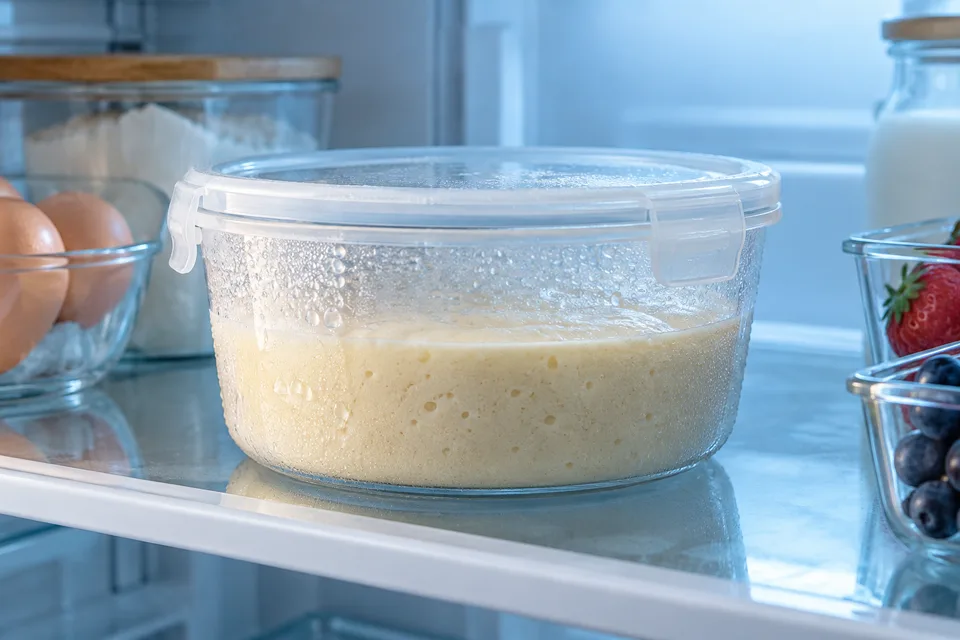
Thawing and baking need their own checks
Allow sufficient refrigerated thawing time for the portion. A soft edge with a frozen center is not an evenly thawed mixture. Follow the recipe about whether any gentle redistribution is needed; do not automatically whip the batter to smooth it.
Keep track of time outside refrigeration while you prepare the pan and preheat. A chilled batter may bake on a different schedule from freshly mixed room-temperature batter. Use the recipe's doneness cues rather than blindly repeating the original minute count.
Check the center as well as the surface. If the cake rises and then collapses, freezing may have changed the mixture, but pan depth and incomplete baking are still possible causes. See why cake sinks in the middle for a fuller diagnosis.
Do not repeatedly thaw and refreeze a working batch
Repeated cycles make quality harder to predict and add handling opportunities. Divide the batter before freezing so you can thaw only what you need. If a batch's time-temperature history is unclear, do not treat another freeze as a reset.
Record the outcome of a small trial: texture, rise, baking time and any separation. Those notes apply to your recipe and process. They should not be generalized into a claim that all batters keep identically.
When baked layers are the better plan
Why baked layers are often the easier make-ahead choice
A baked cake already has its structure set. Freezing a suitable plain layer avoids asking raw batter to retain its original air and leavening behavior through storage. It also simplifies the final day: thaw, decorate and serve according to the recipe.
Cool and package baked layers as the recipe directs. Protect surfaces from drying and odors, and label sizes and dates. Some fillings and frostings have separate freezing and thawing limitations, so freezing plain layers first can be more flexible.
This is a planning recommendation, not a promise that every cake freezes beautifully. Fruit-heavy cakes, delicate decorations and particular dairy fillings may change texture. Choose a recipe with a clear make-ahead method for an important event.