Baking soda needs suitable acidity in the recipe to release useful carbon dioxide. Baking powder contains both a base and acidic ingredients, so it does not depend on a separate acidic food in the same way. Use the one the recipe specifies, in the measured amount. They are not interchangeable teaspoon for teaspoon.
The choice affects more than height. It can influence flavor, browning and the batter's balance. Understanding the difference helps explain a bitter cookie or collapsed cake without turning every recipe into a chemistry experiment.
Two leaveners, two different starting points
What baking soda does
Baking soda is sodium bicarbonate. In a suitable moist, acidic mixture, it reacts to produce gas. The batter or dough needs a structure that can hold those bubbles until baking sets it. Gas production alone does not guarantee a light result.
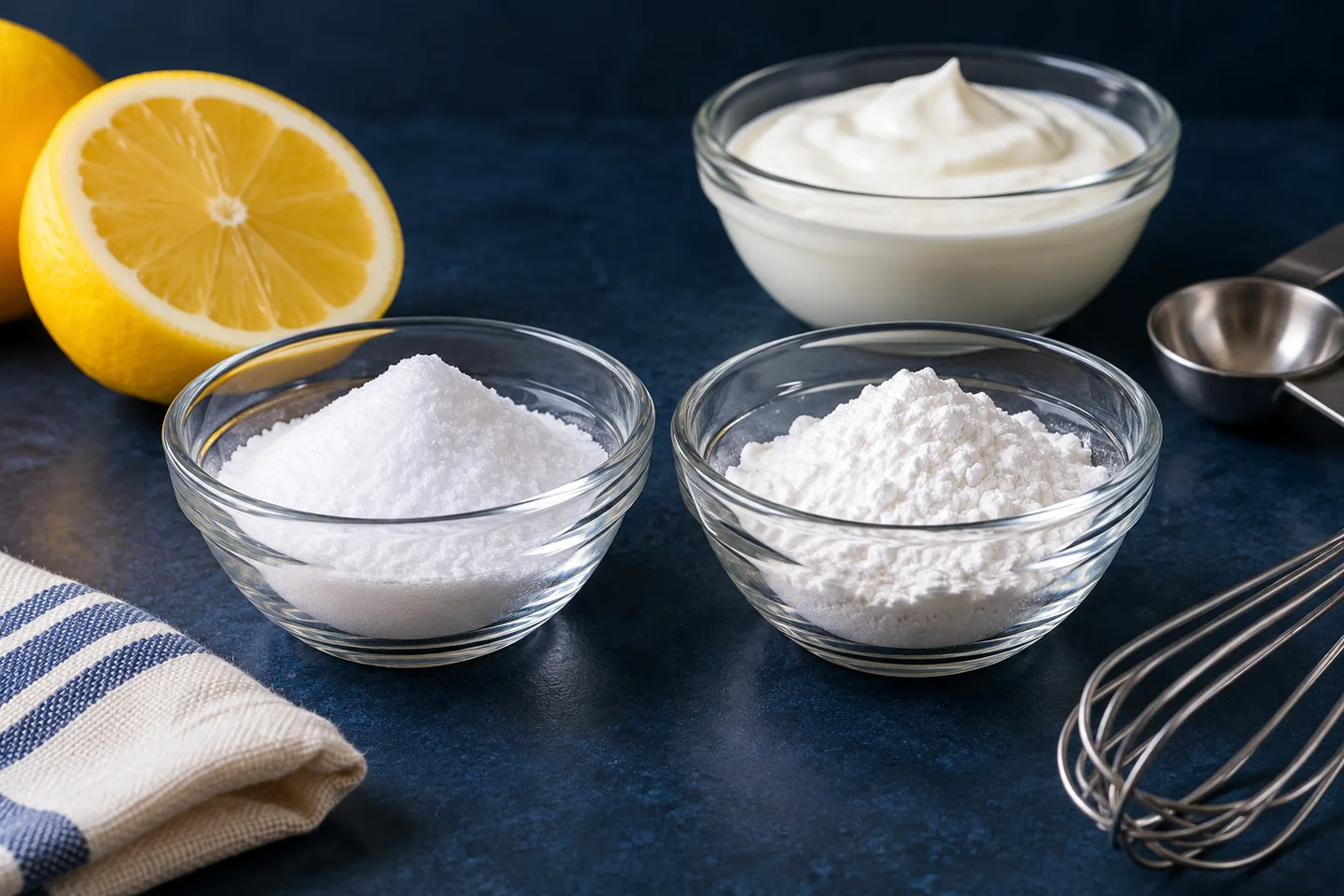
Buttermilk, yogurt, lemon juice and natural cocoa are examples of ingredients that can contribute acidity. Their actual amounts and acidity matter. A small squeeze of lemon does not automatically balance any quantity of soda you decide to add.
Soda also changes the mixture's acidity. Too much remaining soda can cause an unpleasant taste and affect color or spread. Reducing acidic ingredients while keeping soda unchanged can alter the balance even if the batter still looks normal.
Natural and Dutch-process cocoa are not the same
Natural cocoa can contribute acidity, while Dutch-process cocoa has been treated to reduce acidity. If a recipe specifies one, use it initially. Swapping cocoa types is especially important to assess when baking soda supplies the leavening.
Some chocolate formulas are forgiving because they contain other acidic ingredients or use baking powder, but that does not create a universal cocoa-swap rule. Follow the particular recipe's guidance.
What baking powder adds to the formula
Baking powder combines bicarbonate with acidic components and usually a starch carrier. It is a formulated mixture, not simply another name for soda. The exact acidic ingredients can vary by product.
Double-acting baking powder releases gas in more than one stage, including a heat-related stage. This can give a batter some useful flexibility, but it does not mean mixed batter can sit indefinitely without changing. Moisture, time, temperature and the batter's structure still matter.
King Arthur's explanation of the two leaveners confirms the key distinction and cautions against equal substitutions. Use that as a starting point for reading recipes, rather than a reason to replace ingredients casually.
Compare their jobs in a complete recipe
A practical side-by-side comparison
| Question | Baking soda | Baking powder |
|---|---|---|
| What is it? | Sodium bicarbonate | A mixture including bicarbonate and acidic ingredients |
| Does recipe acidity matter? | Yes, for useful reaction and balance | The product supplies acidic components, though the whole recipe still matters |
| Can they replace each other equally? | No | No |
| What should you follow? | The recipe's amount and ingredient choices | The recipe's amount and the product's directions |
Do not reduce the difference to “soda spreads and powder puffs.” Those shorthand phrases can be memorable, but a cookie's behavior depends on the full formula. A batter with the wrong balance is not fixed simply by choosing the word associated with your desired shape.
Why a recipe can use both
A recipe can contain soda to interact with acidic ingredients and powder to supply additional lift. The formula may deliberately leave some acidity for flavor while providing enough gas for the intended texture. Seeing both on the ingredient list is not evidence that one is redundant.
Omitting either can change the outcome. Doubling one because you ran out of the other can change flavor and structure as well as gas production. The safe first interpretation is that the author included both for a reason.
Consider a buttermilk cake as an illustrative example. The cultured dairy changes flavor and composition, not just acidity. Replacing it with plain milk changes more than the soda's reaction partner. A recipe designed for plain milk is a better starting point than adding arbitrary lemon juice and hoping the rest stays identical.
Read the ingredient list as a connected system
When a recipe includes cultured dairy, natural cocoa or citrus, note those ingredients alongside the soda. When it also includes powder, do not cross it out as duplication. The formula may be balancing flavor, gas production and structure at the same time.
Look at the mixing sequence as well. A quick batter that goes into a prepared pan immediately has a different schedule from a cookie dough designed to rest. Do not infer that a chemically leavened mixture must always be baked in the same number of minutes after mixing; follow the specific formula's method.
Three pantry situations with different responses
If you have the specified powder and soda, use the recipe as written. Check each label before measuring and return the containers to different positions on the counter so they are less easy to confuse. A simple organization step prevents a chemistry problem before it begins.
If you have powder but the recipe needs soda, look for a recipe-specific substitution or another recipe. A generic increase in powder can add more than gas: it adds acidic components and carrier ingredients. The original acidic food remains in the mixture, so flavor can change.
If you have soda but the recipe needs powder, adding soda alone is not an equivalent replacement. A suitable acid and a coherent revised formula are needed. For a beginner, choosing a soda-based recipe is often more dependable than assembling an emergency leavener while the batter waits.
Do not confuse baking ingredients with cleaning products
Use a product labeled for food use in a food recipe. A familiar name on a household-cleaning container does not establish that every product carrying that name is intended for baking. Check the packaging and keep food ingredients clearly separated from cleaning supplies.
Likewise, baking soda is not the same as washing soda. Similar-looking names can refer to different substances. The label is more reliable than the powder's color or a remembered household use.
Measure, scale and store the right product
Small spoonfuls deserve careful measuring
Use actual measuring spoons rather than cutlery. Check whether the recipe expects level measures, then level with a straight edge. A heaped teaspoon can vary considerably and is not a controlled way to get a higher rise.
Read “teaspoon” and “tablespoon” twice when scaling. Three teaspoons make one US tablespoon, so confusing the two can create a large leavener error. Write scaled small ingredients down before starting instead of calculating while the mixer runs.
Distribute the leavener through the dry ingredients as the recipe directs. A pocket of powder can create an uneven taste or local expansion. If the recipe asks you to sift or whisk the dry mixture, that is part of achieving an even batter.
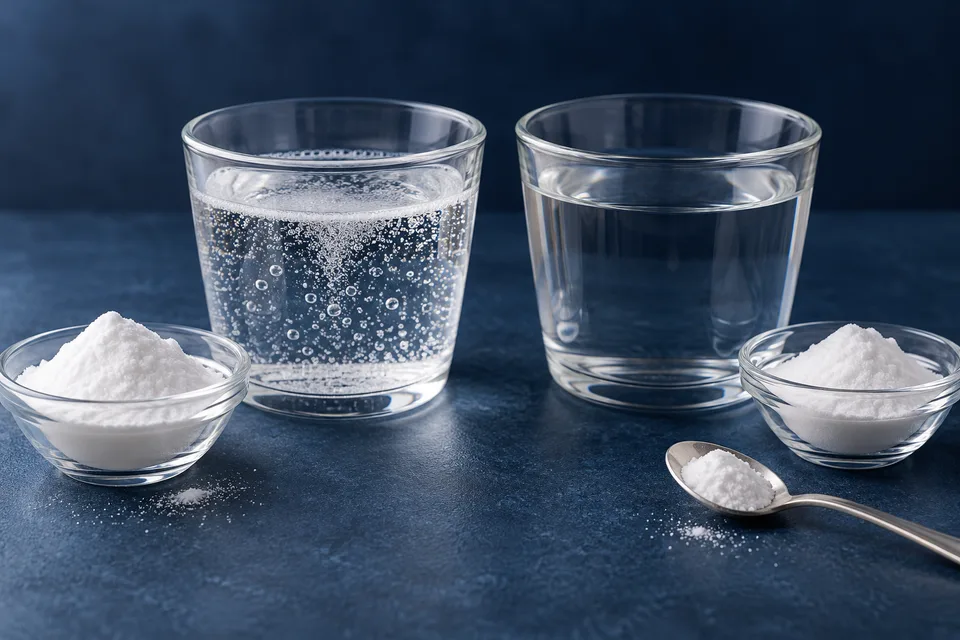
A kitchen fizz check has limits
A small separate sample of baking powder in warm water can show activity. Soda needs an acidic liquid for a meaningful simple reaction check. Bubbling is a clue that something reacts; it is not a precise measurement of the product's remaining strength.
Do not return a test sample to the package or use the liquid in your batter. Keep the jar dry. If the product has been stored poorly or is doubtful, replacing it is more predictable than increasing its quantity to compensate.
Scaling a small leavener amount without guesswork
Suppose you reduce a recipe to half its size. Write the new leavener amount down before mixing, and use a measuring tool that can represent it. A half batch still needs its other ingredients scaled consistently; halving flour while keeping the original leavener is not a controlled smaller cake.
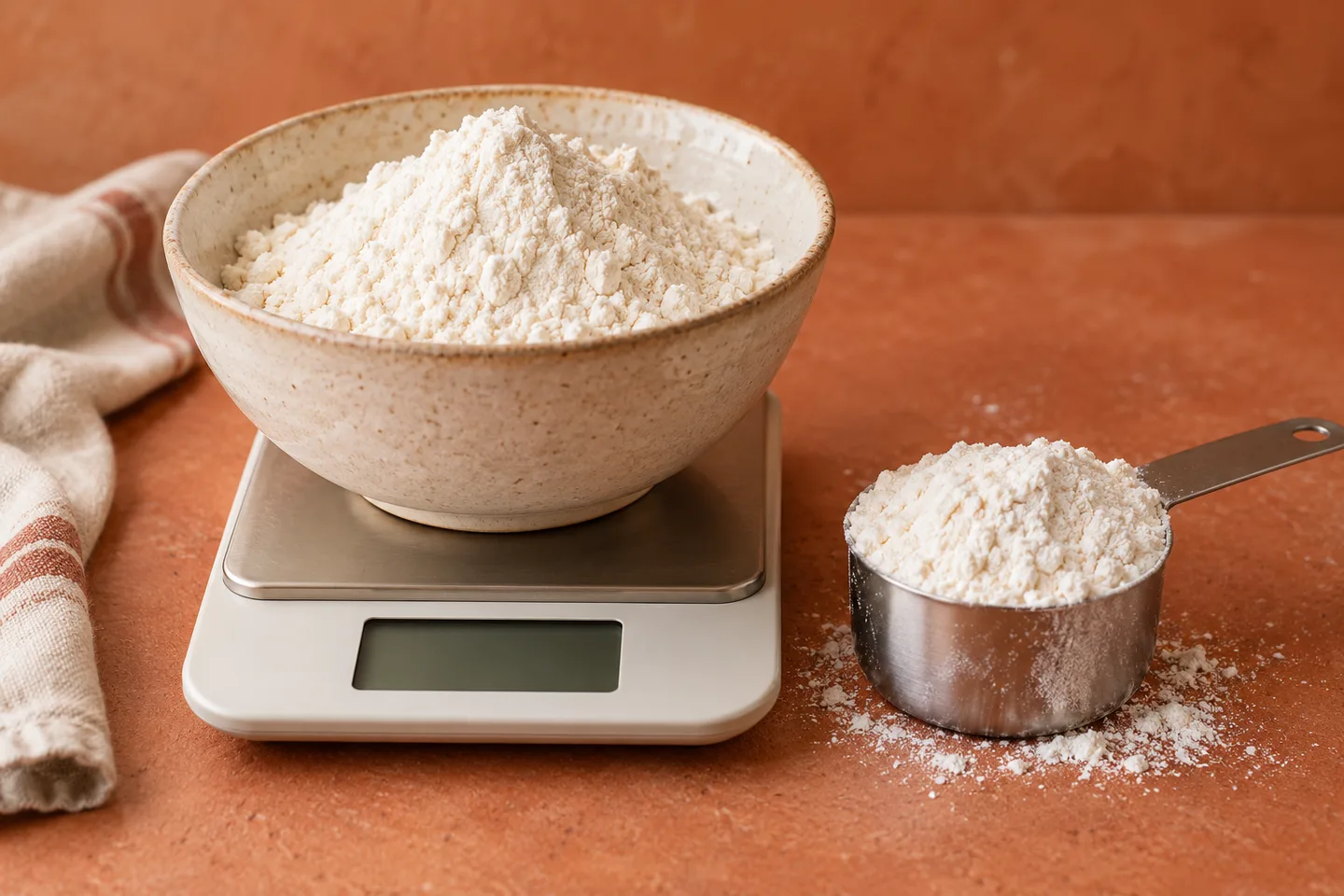
For awkward fractions, a precision scale may help only if it is accurate at that small quantity and the recipe provides a suitable weight. A general kitchen scale that changes in whole grams can be too coarse for some small doses. Do not assume any digital display makes the amount precise.
If the fraction is impractical, choosing a recipe already designed for the smaller pan can simplify the process. This also avoids errors in egg portions, mixing reach and batter depth. Ingredient arithmetic is only one part of scaling a bake.
When a scaled recipe fails, check the written conversion before changing the chemistry. A misplaced decimal, an unhalved spoonful or a self-rising flour substitution can explain a problem that looks like poor leavener performance.
Keep a short record of the product, amount and any substitution. If the result is good, repeat it before generalizing. A successful emergency swap in one formula does not establish a universal conversion for every cake, cookie or quick bread.
Store the powders so the recipe remains repeatable
Close containers tightly and keep them dry, away from stove steam. A wet measuring spoon can introduce moisture into the package. Label any transferred powder clearly; two unlabeled white powders are not a useful baking system.
Check package dates and the manufacturer's storage guidance. A date is one clue, while damp clumps or poor handling add another. Do not rely on a single universal storage period for every brand and opened container.
Buy an amount you can use reasonably. A giant bargain container that spends years near a hot hob may be less practical than a smaller, well-kept package. Accurate measuring depends on having the ingredient you think you have.
When an ingredient is missing or the result is wrong
What to do when you run out
First, consider choosing another recipe. That can be simpler than rebuilding the acid-base balance in the middle of mixing. A recipe using the leavener available in your cupboard has already accounted for it.
If you need a substitution, use a reliable recipe-specific direction. Replacing soda with powder can add acidic ingredients and extra carrier material. Replacing powder with soda requires an appropriate acid and changes the formulation. Neither is an equal swap.
Do not use an improvised conversion to justify a large batch or an important occasion without a small trial. A workable emergency substitution is still a changed recipe. Record it so you do not later blame the oven for a formulation difference.
Self-rising flour is another separate case
Self-rising or self-raising flour already contains raising agents and usually salt. Replacing plain flour with it while keeping every original spoonful of leavener can produce an unintended amount. Replacing it with plain flour can remove ingredients the recipe needs.
Use the product in recipes written for it, or follow a stated conversion. Regional flour names and formulations differ, so read the package rather than assuming one country's product matches another.
Diagnose the result without overcorrecting
A cake that rises dramatically then collapses may involve excess leavening, but underbaking and pan depth are also possible. A bitter or soapy flavor raises questions about soda quantity and balance. A dense bake may involve measurement, mixing or weak leavener.
Read why cakes sink in the middle to assess the full process. For spread, see why cookies spread too much. Do not assign every symptom to a spoonful of powder.
For make-ahead plans, our cake-batter freezing guide explains why reaction timing and structure matter. A batter that contains double-acting powder still needs an appropriate freezing and thawing method.