Bread flour generally contains more protein than all-purpose flour, which gives many wheat doughs a stronger framework for holding gas. That can mean a chewier crumb and better support for a tall loaf. All-purpose flour is more adaptable, and it can make excellent bread when the recipe is designed around it. Neither flour is automatically better for every bake.
The important comparison is between the actual products in your cupboard, not just the names on their bags. Protein content, wheat variety, milling and local labeling conventions vary. A substitution that works in a simple sandwich loaf may be less useful in a delicate cake or a very wet artisan dough.
The useful difference: strength and texture
How the two flours tend to behave
| Question | Bread flour | All-purpose flour |
|---|---|---|
| Typical strength | Usually more structural support in wheat yeast dough | Often a balance between structure and tenderness |
| Texture goal | Useful for chew and resilient crumb | Useful for softer, more general baking needs |
| Water needs | May absorb more water | May make the same formula feel softer |
| Common uses | Bagels, many yeast loaves, some pizza doughs | Cookies, quick breads, many sandwich breads and cakes |
| Best first choice | The flour specified in the recipe | The flour specified in the recipe |
These are tendencies, not a rigid ranking. A moderately strong all-purpose flour can be a good fit for bread, while a very strong bread flour may produce more chew than you want. A recipe developer's choice helps establish the expected balance.
What protein changes in wheat dough
When wheat flour is hydrated and worked, its gluten-forming proteins help create an elastic network. That network supports the bubbles formed during fermentation and expansion in the oven. A flour with more suitable protein can make it easier to build a dough that stretches without tearing immediately.
This does not mean protein is the only ingredient in successful bread. Water, mixing, resting, salt, fermentation and shaping all influence the result. A high-protein flour in a dry, underproofed dough can still produce a heavy loaf. The flour provides potential; the method has to make use of it.
Protein numbers are also not interchangeable with a direct measurement of finished gluten strength. Different wheat proteins behave differently. Whole-wheat flour can have a high protein number but also contain bran that changes how the dough expands. A rye flour protein value cannot be used to predict behavior as though it were white wheat flour.
Use the manufacturer's specification where available
Nutrition labels often round the protein in a small serving. Dividing the rounded grams of protein by serving weight can give only a rough estimate. A stated flour specification is more useful when comparing two products closely.
For example, King Arthur's comparison lists its bread flour at 12.7% protein and its all-purpose flour at 11.7%. Those are examples of two named products, not universal definitions of bread flour and all-purpose flour across every brand or country.
Choose flour for the result you want
Choose by the bread you want to eat
Sandwich loaves
A soft sandwich loaf needs enough structure to rise and slice, but it does not have to resist your bite like a bagel. Either flour may work in a recipe developed for it. Fat, sugar, milk and mixing method can influence softness alongside the flour.
If your regular loaf is pleasantly soft with all-purpose flour, switching to bread flour is not an automatic upgrade. If the dough repeatedly feels fragile at the intended hydration, a stronger flour may be worth trying, provided you also check measuring and fermentation.
Bagels and chewy breads
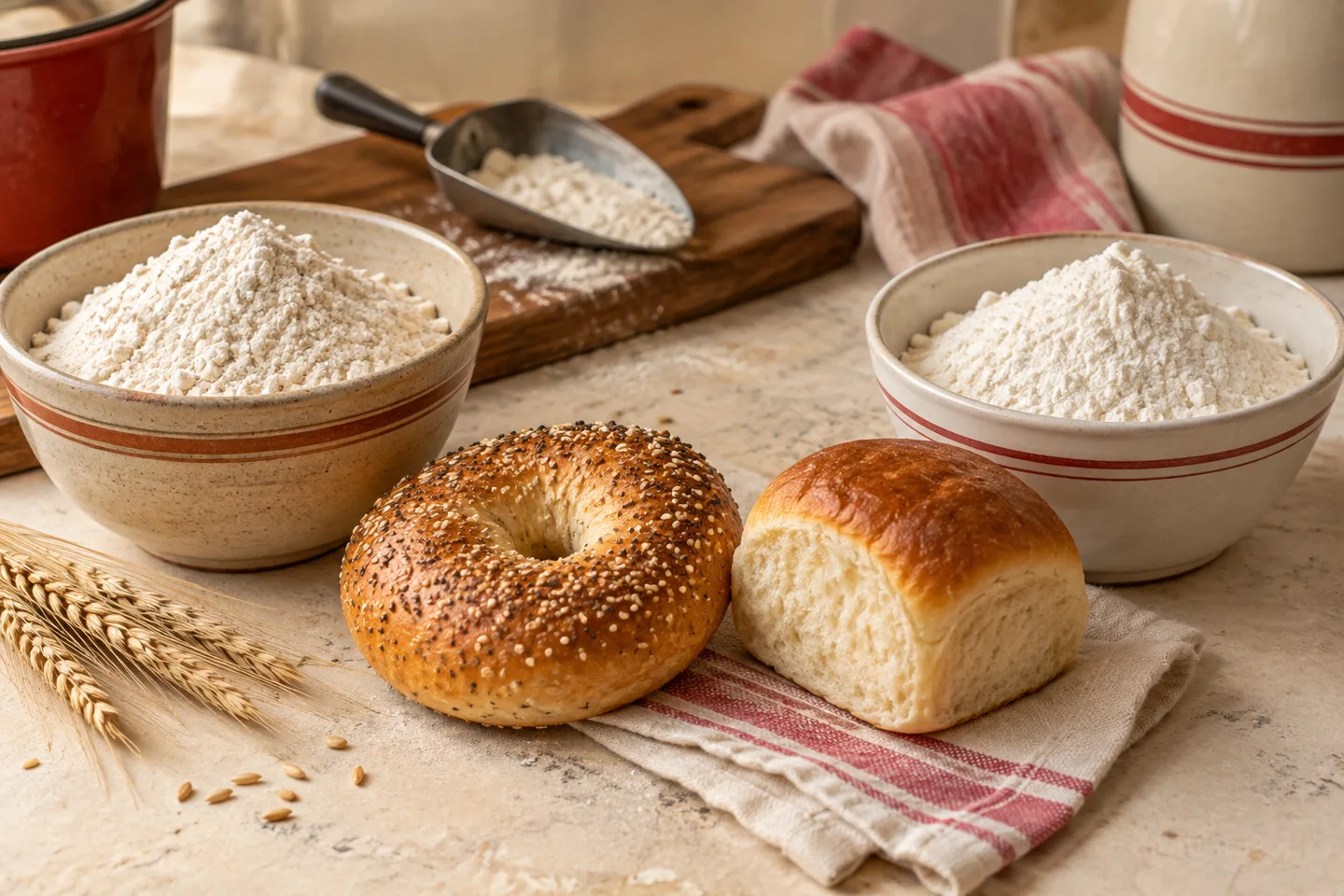
For recipes that aim for chew, bread flour is often the more straightforward choice. Bagel dough is typically relatively firm and shaped to hold a defined form. A weaker flour can change the feel of that dough even if it still produces an edible result.
Do not turn a softer dough into bagel dough simply by adding unlimited flour. Choose a recipe that specifies its flour and liquid balance. Texture is an interaction between formulation and method, not a single ingredient's job.
Pizza and long-fermented dough
Pizza flour selection depends on the crust style, fermentation schedule and oven. All-purpose flour can suit some home pizza formulas. Bread flour can provide more chew and resilience. Specialized pizza flour may have a different balance, and a “00” label describes milling or grading conventions rather than automatically meaning high protein.
Very wet doughs need enough support to hold shape, but maximizing protein is not the only way to get an open crumb. Fermentation and handling remain crucial. Our article on dense homemade bread explains why flour choice alone cannot resolve every tight crumb.
What happens in cakes, cookies and quick breads?
In a tender cake, bread flour can provide more structure than the formula needs. The result may feel firmer or less delicate, particularly if the batter is also mixed heavily after flour is added. Cake flour, where specified, is a separate product and should not be casually replaced by bread flour.
Cookies can tolerate a range of flours, but chew, spread and thickness may change. A chocolate chip cookie recipe formulated around bread flour is not a reason to replace the flour in every cookie recipe. The amount of fat and sugar, dough temperature and baking surface also affect spread.
Quick breads rely on chemical leavening rather than yeast fermentation. Their texture depends on the recipe's balance and how the batter is mixed. All-purpose flour often fits the desired tender crumb; a stronger flour is not necessarily beneficial just because the product is called “bread.”
The same distinction applies to pancakes, muffins and biscuits. Follow the recipe's flour choice when tenderness matters, and read how baking soda and baking powder differ before changing the leavening to compensate for a flour substitution.
Make a substitution you can repeat
A careful way to substitute one for the other
For many ordinary wheat yeast recipes, a weight-for-weight substitution is a reasonable starting experiment. Use grams, not a different number of loosely filled cups. Keep the other ingredients and process consistent so you can understand the change.
- Check whether the recipe specifically warns against flour substitutions.
- Replace the flour by weight for a small batch, keeping a record of the products used.
- Mix and allow the dough its specified rest before deciding whether the texture is wrong.
- Make only a small, measured water adjustment if the dough is clearly stiffer or looser than the recipe describes.
- Watch the dough's development and proofing cues, then compare the cooled loaf.
There is no universal rule to add an exact spoonful of water for every cup of bread flour. Products and recipes vary too much. If the dough is slightly firmer, adding a few grams of water and noting the result is more controlled than pouring until the bowl looks right.
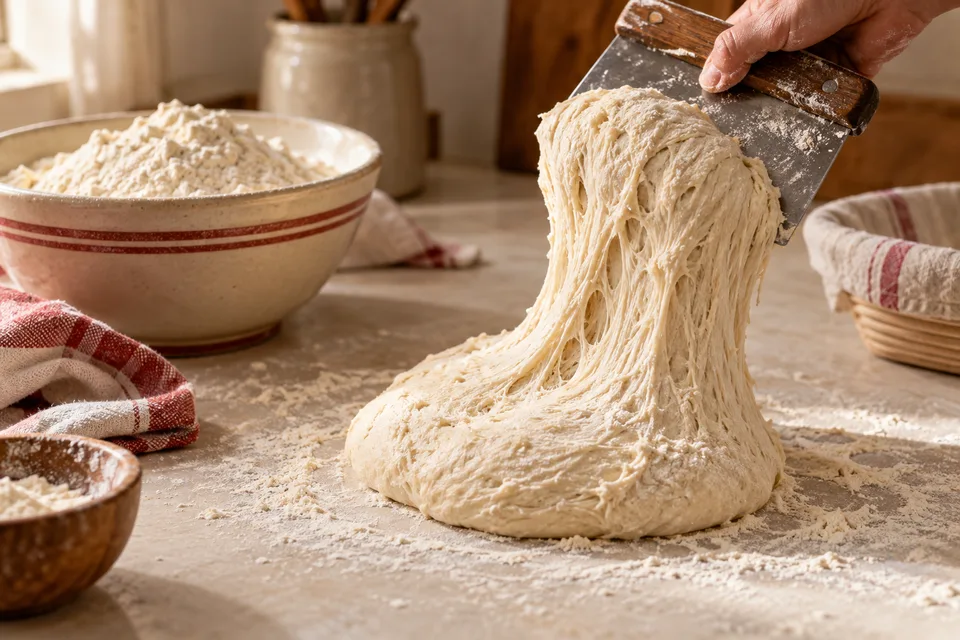
When a substitution deserves more caution
Be cautious with a very high-hydration loaf, a strongly enriched dough, a recipe using flour blends, or a formula designed for a particular flour's absorption. A change may affect kneading feel, fermentation appearance and shaping, not just the final chew.
If replacing bread flour with all-purpose makes the dough noticeably slack, avoid immediately adding lots of flour. A rest, the prescribed folds and careful handling may help. If it still cannot hold the intended form, choose a recipe built for the flour you have rather than fighting it throughout the bake.
See our flour-measurement guide for the role of packing and cup conversions. A measurement error can be larger than the effect you were trying to study.
A flour comparison you can actually learn from
Choose a simple wheat bread recipe and make a small batch with the specified flour first. Note how the dough feels after the same rest, how much it expands, and how the cooled crumb slices. This gives you a baseline that a package description cannot provide.
For the second batch, change only the flour product by weight. Keep yeast, salt, pan, mixing method and intended dough temperature the same where possible. If the new flour requires a modest water adjustment to reach the recipe's described feel, measure and record that adjustment.
Compare at the same stage. A warm loaf can seem softer than a cooled one, and a next-day slice differs from a fresh slice. Judge both after comparable cooling and storage. The result is a useful household observation, not a universal claim about all flour brands.
Decide which quality matters
For a lunch loaf, the relevant question may be whether slices remain flexible and hold a filling. For a bagel, it may be pleasant chew. For pizza, stretchability and the baked crust can matter more than tall loaf height. “Better flour” has no meaning until you name the desired result.
If the stronger flour gives more chew than you want, that is not a failed comparison. It tells you the original all-purpose flour may suit the task. If it improves support in a wet dough, keep the new water and handling notes so the improvement can be repeated.
Keep recipe names honest
When sharing an adapted recipe, identify the flour you used and the weight rather than publishing only “one bag of bread flour.” Other bakers may live where the label means something different. A clear ingredient description and a dough-texture cue give them a better starting point.
Do not describe a simple home comparison as proof of a laboratory protein-performance relationship. Product specifications, kitchen observations and established baking principles are different kinds of information. Keeping them separate makes the advice more useful and trustworthy.
Read the bag, then buy for your routine
Labels can mislead when recipes cross borders
In the United Kingdom, “strong white flour” commonly points toward a flour intended for bread. In North American recipes, “all-purpose” and “bread flour” are more common terms. Australian and Canadian products can have their own labeling and protein patterns. Similar names do not guarantee identical behavior.
“Plain flour” means it has not been combined with raising agents; it does not, by itself, tell you its exact strength. Self-raising or self-rising flour contains leavening and usually salt, so it is not a direct substitute for plain bread flour in yeast dough.
Read the ingredient list as well as the name. If a recipe from another region specifies a product you cannot buy, look for the intended use and published protein information, then make a small batch. Avoid assuming a US cup, a metric cup and the author's flour weight are identical.
What to buy and how to keep the comparison fair
If you bake occasional loaves as well as cookies and cakes, a reliable all-purpose flour may cover most of your routine. Add bread flour when a recipe or preferred style benefits from it. Keeping two enormous bags is not helpful if one sits open so long that it picks up odors or becomes difficult to identify.
Store flour dry, protected from pests and clearly labeled with the product name and date. Whole-grain flour has different keeping considerations because it includes the grain's oils; follow package guidance. Never identify a flour solely by its white appearance.
For a useful home comparison, split one recipe into two small batches and use each flour without changing several other factors. Treat that as your own kitchen observation, not a controlled scientific trial. Record water adjustments and dough temperature so the next comparison has context.