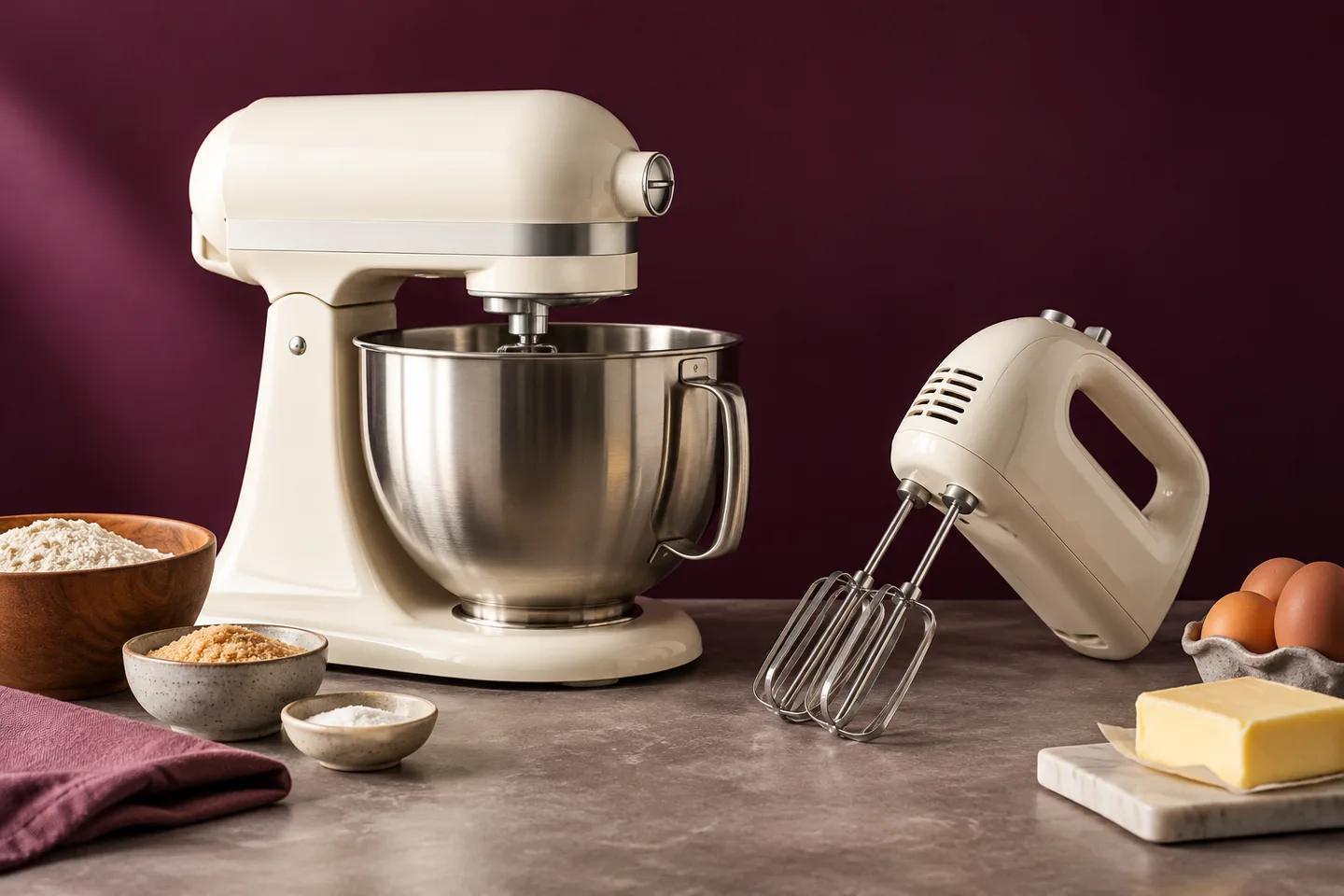
Choose a hand mixer if you mainly make modest batches of cake batter, whipped cream and other mixtures it is rated to handle. Choose a suitable stand mixer if you regularly mix larger batches, want supported hands-free operation, or make doughs within its stated capacity. If you mostly bake stir-together recipes, you may not need either yet.
The decision should start with your tasks and physical comfort, not motor wattage or the appearance of a baking kitchen. A bigger machine is useful only when it fits your routine and can do the work safely.
Identify the mixing job and the person doing it
List your three most frequent mixing jobs
Write down what you actually make or plan to make repeatedly. “One cake a month,” “weekly sandwich bread” and “large holiday cookie batches” point toward different equipment. Separate those regular tasks from an ambitious recipe you might try once.
Also note batch size and duration. A short cream-whipping task differs from sustained work on a stiff dough. Some hand mixers include dough hooks, but that does not mean they can handle every bread formula or quantity.
| Task | Hand mixer consideration | Stand mixer consideration |
|---|---|---|
| Small cake or cream batch | Compact and often sufficient if rated for the task | Tools may not reach a very small amount well |
| Frequent larger cookie batches | Holding and moving it may become tiring | Suitable capacity and paddle can be useful |
| Bread dough | Check explicit dough and quantity limits | Check dough capacity, hook and prescribed speed |
| Limited storage | Easier to put away | Needs counter or safe lifting space |
| Reduced hand strength | Weight and sustained grip may be difficult | Controls and bowl handling still need assessment |
Three task profiles with different choices
An occasional cake baker making small batches may find a suitable hand mixer easy to store and adequate for the work. The important checks are comfortable grip, low-speed control and the ability to clean the attachments as directed.
A frequent bread baker may benefit from a stand mixer explicitly rated for the intended dough and quantity. The decision depends on stiff-dough limits, permitted speed and supervision, not simply the largest bowl. A no-knead or fold-based method remains a valid alternative if it suits the routine.
A baker with limited lifting comfort may value a permanent stand-mixer location, but still needs to assess bowl weight and access. Someone with limited counter space may prefer a lighter tool that can be put away. These are practical differences, not a ranking of which baker is more serious.
Read one representative task in the manual
Before buying, find the instructions for the task you will perform most often. Check attachment, quantity, speed, rest or mixing-time limits, and cleaning. If that information is unclear, ask the maker or choose a product with clearer guidance.
Do not use a seller's general “powerful motor” phrase in place of a dough-capacity statement. A task-specific limit tells you more about whether the machine fits your baking.
Keep the recipe method visible
Once you own the machine, write the equipment settings beside the recipe's texture cues. The motor can run while the mixture changes quickly, so keep watching. A timer helps organize work, but the dough or batter still needs assessment.
If a recipe was written for another machine, adapt only within your manual's limits or use a different method. Never exceed a stated capacity to reproduce a photograph of a large batch.
A useful mixer makes familiar tasks easier and repeatable. It does not need to be the most expensive model, and it does not replace accurate ingredients, safe handling or a coherent recipe.
Physical comfort can change the answer
A hand mixer may be easier to store but harder to hold for several minutes. A stand mixer reduces that particular effort but still requires handling the bowl, attachments and ingredients. Think through the entire task, including cleaning.
Check control placement and whether you can add ingredients safely. A heavy bowl can become harder to manage when full. A permanent counter location may solve lifting the machine but not lifting the batter bowl.
If possible, assess the weight and access before buying. Do not assume a heavier appliance is always safer or more comfortable. Choose the arrangement that fits your own needs without exceeding equipment instructions.
Compare the two tools in actual use
When a hand mixer is enough
A hand mixer is flexible because you can move the beaters through an appropriate bowl. It stores more easily than a large countertop machine and can suit occasional baking. Check the tool's weight in your hand, not just its packaging dimensions.
For creaming and whipping, control at low speed is valuable. A very abrupt first speed can throw dry ingredients from the bowl. Read the instructions about when to insert beaters and how to start a mixture without splashing.
A comfortable handle, accessible speed switch and stable resting position can matter more than an extra attachment you will not use. The cord should reach a suitable outlet without crossing a hot surface or creating a tripping hazard.
The effort is still in your hand
You hold and guide a hand mixer while it works. For a long mixing task, that can become tiring even if the motor is capable. A heavy mixer is not automatically the better tool for a person with limited grip or wrist comfort.
For thick dough, stop if the task exceeds the manual's limits. Do not force beaters through a mixture simply because they still turn. A strained motor, unusual smell or overheating is a reason to stop and follow the manufacturer's troubleshooting instructions.
When a stand mixer earns its space
A stand mixer supports the bowl and attachment, reducing the need to hold the machine throughout the task. A suitable model can make repeated creaming, mixing and dough work more convenient. It also requires room to operate and access the bowl.
The usable batch range matters as much as maximum capacity. A large bowl may be awkward for a very small quantity, while a small model may not suit heavy repeated batches. Look at the manufacturer's task-specific limits rather than only its advertised bowl volume.
KitchenAid's comparison identifies recurring large or dough-heavy tasks as reasons to consider a stand mixer. That is manufacturer guidance, not an independent ranking or a claim that one brand is necessary.
Counter space includes clearance
A tilt-head model needs room to lift the head; a bowl-lift design has a different access pattern. Check height under cabinets, side space for removing the bowl, and the route to storage. A machine you cannot safely lift should have a permanent suitable location.
Do not place the mixer near a counter edge or on an unstable surface. Watch its behavior during approved tasks, especially dough mixing. Hands-free does not mean unattended indefinitely.
Check attachments, dough limits and power claims
Attachments solve different problems
A wire whisk incorporates air into appropriate light mixtures. A flat paddle combines many batters and cookie doughs. A dough hook works suitable bread dough under the machine's specified conditions. These are not interchangeable simply because they fit the hub.
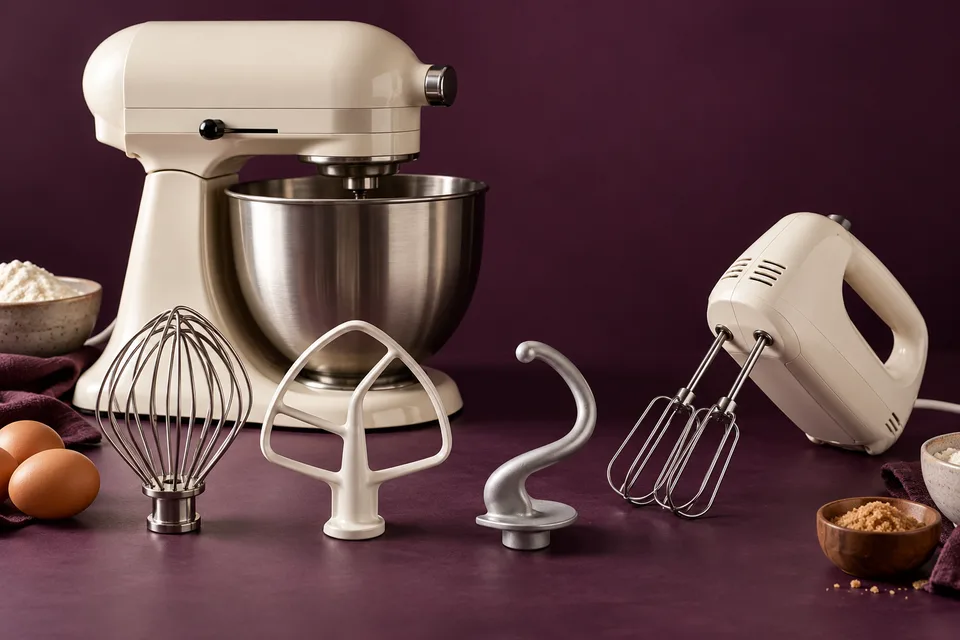
The image illustrates common attachment shapes, not a compatibility chart. Use only attachments approved for the exact machine. A tool that looks similar can have a different fit or clearance.
Scraping and attachment changes require stopping
Turn the mixer off before scraping the bowl or changing tools, and unplug it where the manual directs. Keep fingers, spatulas, hair and loose clothing away from moving parts. Do not reach into a running bowl to rescue a clump.
Use a flexible spatula appropriate for the mixture and resume only when the bowl and attachment are properly secured. A repeated need to scrape is normal for some methods; it is not a reason to hold a spatula beside a moving paddle.
Bread is where capacity claims need careful reading
A bowl volume does not tell you how much stiff dough a motor and drive system can handle. Manufacturers may state flour limits, dough weights, speed restrictions and mixing intervals. Those conditions are essential to the capacity claim.
KitchenAid's bread-mixing guidance gives model-specific handling principles. For any brand, use the exact manual rather than copying a speed from another machine.
Do not convert a hand-kneading time directly into a mixer time. Machine action can develop and warm dough differently. Observe the dough and follow both the recipe and equipment instructions. If they conflict, choose a method that fits the equipment's permitted use.
A mixer cannot fix a flawed dough
Excess flour, inactive yeast or an unsuitable fermentation schedule remain problems even in an expensive mixer. Mixing longer can make the dough warmer without addressing the cause. Read why bread becomes dense before assuming a purchase will solve the loaf.
Many breads can be made with hand kneading, folds or a no-knead method. If those suit your comfort and schedule, there is no need to buy a stand mixer solely because a bread photograph shows one.
Why wattage is not a complete performance score
Wattage describes electrical input, not a universal measure of useful mixing force, efficiency or durability. Design, gearing, attachments, permitted task loads and cooling all matter. Comparing two numbers without context can be misleading.
Read task-specific specifications and the manual. Check whether the maker describes the dough quantities you intend to use and whether replacement parts or service are available in your region. Do not treat vague marketing terms as measurable capacity.
Noise, vibration and ease of control also affect daily use, but this journal has not performed a hands-on product comparison. If those factors are important, examine a demonstration or return policy from a reliable seller rather than relying on invented testing claims.
Decide what fits your budget and routine
A budget decision without an invented price ranking
For occasional small batches, a suitable hand mixer plus accurate measuring tools may be a more useful purchase than a stand mixer. For frequent approved large tasks, the time and effort saved by a stand mixer may justify its cost and space.
Include maintenance and storage in the decision. Extra bowls and specialized attachments cost more and need somewhere to live. Buy an accessory only when a repeated task gives it a clear purpose.
Read essential beginner baking tools if you are building a kit from scratch. A scale, suitable pans and safe handling equipment remain useful regardless of mixer choice.
A simple decision sequence
- Name your regular recipes and batch sizes.
- Check whether hand mixing already suits them.
- For electric mixing, compare task limits rather than wattage alone.
- Assess holding comfort, bowl access, storage and safe lifting.
- Read the manual and service information before purchase.
- Buy for repeated needs, leaving optional attachments for later.
Whichever you choose, accurate ingredients remain important. See how to measure flour correctly before asking a mixer to compensate for an inconsistent formula.
Own the tool safely and keep the method visible
Cleaning and maintenance are part of ownership
Unplug before cleaning and follow the manual for the machine body and removable parts. Do not immerse an electrical motor unit. Dishwasher suitability can vary between bowls, whisks, coated tools and other attachments.
Dry parts and store them so they do not damage one another. Inspect cords and attachments for damage, and stop using equipment with a safety concern. Do not improvise repairs to a plug, drive or moving tool.
Keep the manual accessible. It is the reference for capacity, speed, attachment fit and cleaning—not a document to discard after assembly. A familiar machine used within its limits is more valuable than a powerful one used by guesswork.